The Age of the Perpetual Re-org
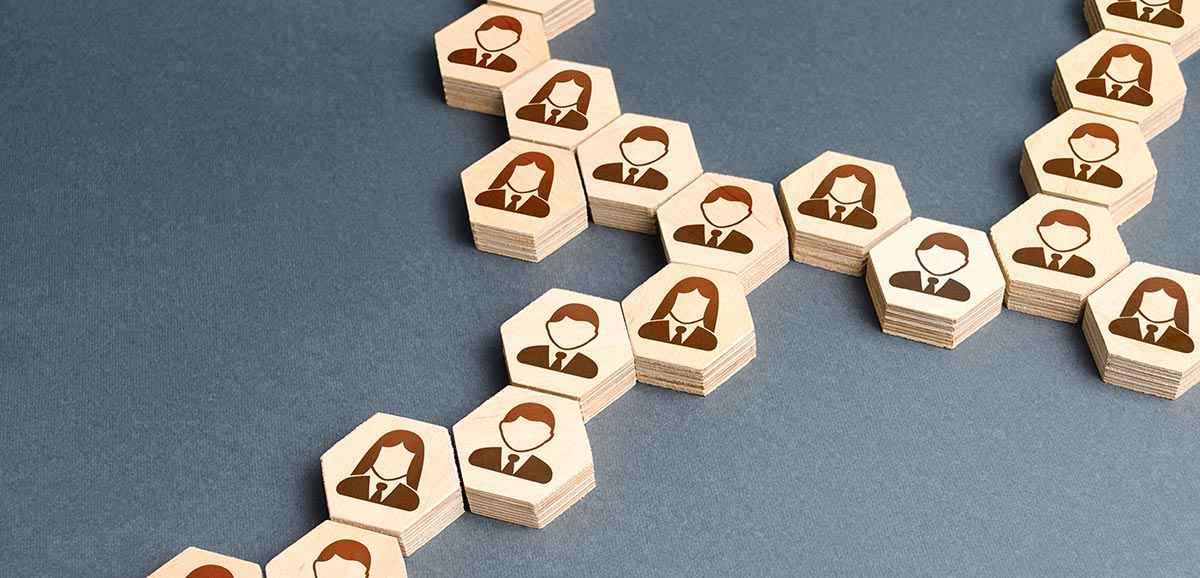
In recent years, the modern workplace has been subjected to a series of unprecedented organizational shocks. From Elon Musk’s high-profile initiatives to downsize the federal workforce to continued corporate layoffs in 2026, the prevailing management playbook has increasingly defaulted to swift, aggressive reconfiguration. Across technology, media, and finance, continuous restructuring has transformed from a rare crisis response into a standing operating strategy. Teams are assembled, reorganized, and disbanded across digital workspaces with the cheerful cadence of a deck of cards being reshuffled between hands.
Behind the clean financial accounting of these restructurings lies an immediate, heavy human toll. Layoffs and sudden reassignments inflict real trauma, fracturing work communities, destabilizing lives, and eroding the basic sense of security that allows people to live comfortably. For those who remain, survivor’s guilt is compounded by the quiet exhaustion of navigating an increasingly unpredictable environment.
While secondary to the personal pain of workforce reductions, there is also a profound long-term institutional cost that corporate balance sheets consistently fail to capture. In the rush to demonstrate agility and streamline balance sheets, organizations often overlook the silent destruction of their internal social architecture. When talent is treated as a set of modular, plug-and-play components, something essential breaks inside the collective mind of the company.
The Fallacy of the Modular Team
For decades, organizational theory has tended to frame team dynamics through a rigid binary choice. On one side stands the romanticized legacy team, bound together by years of shared tenure. While celebrated for its loyalty, this hyper-stable model is frequently feared for its vulnerability to calcified groupthink, insularity, and resistance to change. On the other side stands the hyper-fluid modular team, constantly refreshed with new hires and cross-functional rotations to maintain sharp, unblinkered perspectives.
In an earlier piece on the organizational dynamics of breakthroughs, I examined how genuine breakthroughs require more than polite consensus: they demand the productive clash of opposing ideas. But there is a quiet tension here that easy management binaries tend to overlook. Productive friction cannot exist in an environment ruled by fear and instability. For a team to challenge one another constructively without collapsing into defensive self-preservation, they require an underlying bedrock of mutual trust and psychological safety.
This reveals the fundamental flaw in viewing talent as purely modular. Creative velocity does not spring from a flood of fresh brains alone, nor does it belong exclusively to long-tenured veterans. Instead, it lives in the unwritten transition zones: the invisible network architecture of trust, shared vocabulary, and implicit coordination that takes years to build and seconds to bulldoze through careless restructuring. Team stability, properly understood, is not a static headcount metric. It is an invisible cognitive infrastructure.
The Cognitive Network: Transactive Memory in Action
To understand why structural turnover carries such an underestimated cost, it is helpful to look to cognitive psychology. In the mid-1980s, Daniel Wegner introduced the concept of “transactive memory systems” to describe how human groups collectively encode, store, and retrieve knowledge. Wegner observed that when individuals work together over extended periods, they do not merely share facts; they construct a joint memory architecture.
In a mature transactive memory system, no single person needs to hold all the answers. Instead, the team develops a shared mental index of who knows what. One engineer understands the fragile edge cases of a legacy system; a designer knows how to navigate an ambiguous executive review; a researcher holds the historical context of why a seemingly logical feature failed three years prior.
This distributed memory operates as an external cognitive drive across multiple minds. When a team possesses a robust transactive index, decision-making becomes remarkably swift. Questions are routed directly to the right person, assumptions are verified instantly, and complex tasks are executed with minimal administrative friction.
When management executes a sudden re-org or layoff, they rarely intend to destroy knowledge. Yet by removing individuals, they inadvertently sever the index. The individual expertise may remain scattered across remaining personnel, but the collective directory is wiped. The surviving team is left to navigate the wreckage, spending precious emotional and intellectual energy renegotiating basic communication channels rather than creating anything of value.
Scenius and the Shorthand of Trust
This cognitive network extends beyond internal information retrieval: it shapes the very rhythm of human creativity. The musician and essayist Brian Eno coined the term “scenius” to capture the collective intuition of a tight-knit creative group. Eno argued that history’s most significant cultural and technological leaps were rarely the work of solitary geniuses working in isolation. Instead, they emerged from specific, highly connected communities where individuals developed an intense, unspoken shorthand over years of shared practice.
In a thriving scenius, communication is dramatically compressed. Team members do not need to explain foundational premises or justify their intentions before taking a creative risk. A shared gesture, a brief phrase, or a familiar reference point is sufficient to convey complex ideas.
In today’s remote and hybrid workplace, maintaining this shorthand has become increasingly difficult. As team membership becomes hyper-fluid, Slack channels multiply exponentially, and documentation becomes fragmented across disparate cloud drives. Institutional memory evaporates the moment a senior designer or lead architect logs off for the last time. When pervasive job insecurity permeates an organization, people naturally retreat into defensive postures. The unwritten trust that enables bold creative leaps gives way to cautious compliance and bureaucratic self-defense.
Rethinking Organizational Stewardship
Rather than reducing team health to a list of superficial management tips, we need a fundamental shift in how we conceptualize organizational stewardship. Treating organizations as purely mechanical systems where parts can be swapped without consequence ignores the fundamental reality of human psychology and social organization.
True stewardship requires acknowledging that an organization’s creative capacity is bound up in its relational density. When leaders consider restructuring, they must weigh the short-term financial metrics against the long-term erosion of shared knowledge and psychological safety.
Protecting this invisible architecture does not mean freezing an organization in amber or avoiding hard decisions. Change is inevitable, and fresh perspectives are necessary to prevent stagnation. But renewal works best when it honors the social and cognitive investments already made. When new talent is introduced into a stable, supportive structure, the existing network absorbs and integrates the new perspective. When restructuring is continuous and chaotic, no network can form in the first place.
Reclaiming Human Continuity
In our pursuit of organizational agility, we have often confused structural flexibility with institutional health. Moving boxes on an organizational chart is simple; building a collective mind capable of solving complex, ambiguous problems requires time, stability, and care.
As we navigate an era defined by rapid technological shifts and economic uncertainty, we must recognize that human collaboration remains fundamentally relational. Creative velocity cannot be summoned by directive or engineered through perpetual reshuffling. It grows quietly in the unwritten transition zones where trust, shared vocabulary, and human continuity are allowed to endure.